Category: Uncategorized

  • Custom Knit vs Decorated Blank Beanies: Which Production Route Fits Your Order

    Custom Knit vs Decorated Blank Beanies: Which Production Route Fits Your Order

    Two very different manufacturing paths both get sold as a “custom beanie,” and the gap between them decides your minimum order, your lead time, your budget and what your logo can actually look like. One path decorates a beanie that is already knit, adding a logo to a stock blank. The other knits a beanie from yarn to your specification, building color and pattern into the fabric itself. Picking the wrong path is the most common way a beanie project ends up late, over budget, or looking cheaper than the brief. This guide lays out both routes and how to specify the one that fits the job.

    Two ways to make a “custom” beanie

    The word custom hides a fork in the road. Decorating a blank means a supplier takes an existing knit hat off the shelf, an acrylic cuffed beanie being the workhorse example, and applies your branding to the outside. Full custom knitting means the hat does not exist until your order runs; a factory programs a knitting machine to your yarn, gauge, silhouette and colors, and the design is knit in rather than added on. The first route is fast, cheap to start, and limited to what you can put on a finished surface. The second route is slower and needs volume, but nearly everything about the hat becomes yours to specify. Almost every beanie decision comes back to which of those two trade-offs you are buying.

    The decorate-a-blank route

    This is the route for logos, small runs and tight calendars. Because the blanks already exist, minimums are low (at Get Custom Beanies the minimum order is 12 beanies), and turnaround is short. Branding options include flat embroidery, raised 3D puff embroidery, and patches, whether woven, embroidered, leather or PVC, plus a woven inside label for a finished-goods look. Embroidery usually carries a one-time digitizing setup to convert your artwork into stitches, after which reorders are cheap. The limitation is coverage and detail. Embroidery and patches excel at a clean logo or a small emblem, but they cannot reproduce a photograph, a smooth gradient, or an all-over pattern, and very fine text can fill in on a chunky knit. If your design is a mark that sits on the cuff or the front panel, this route is almost always the right call.

    The full custom knit route

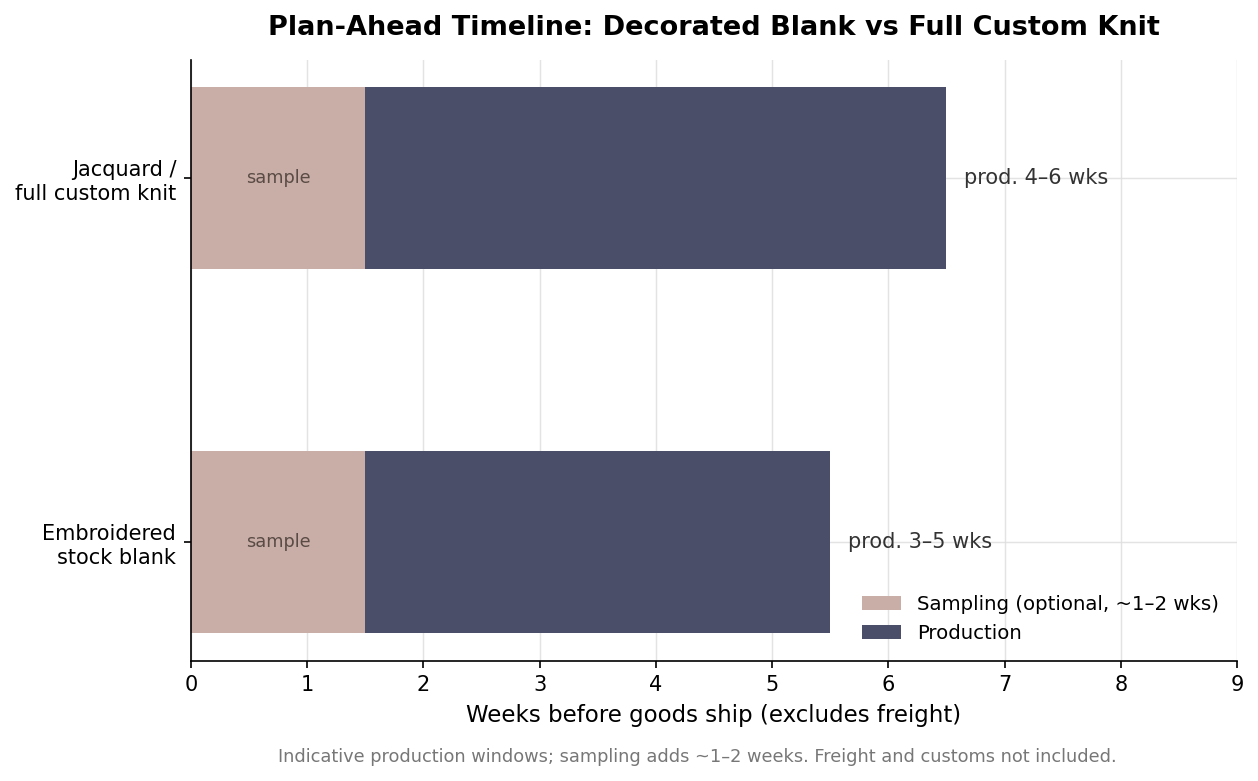
    Knitting from yarn is how you own the whole hat. Here you choose the yarn, acrylic for warmth at low cost, a wool or merino blend for a premium hand, cotton for breathability, or recycled GRS-certified yarn for an eco story, along with the knit gauge, the silhouette, whether it is cuffed, uncuffed, slouch or pom, and the exact colors. Designs are built in with jacquard knitting, which carries two or more yarn colors to knit repeating patterns, stripes, and text directly into the fabric, or with intarsia for blocks of color. Because the artwork is structural, it never cracks, peels or washes off, and you can run brand-specific colorways that no stock blank offers. The cost of that control is a much higher minimum than a decorated blank, which varies with complexity, and a longer, sampling-dependent timeline. This is the route when brand color matching, an all-over pattern, or a genuinely premium feel matters more than speed.

    Lead time decides more orders than people expect

    The calendar quietly eliminates one route on most seasonal projects. At Get Custom Beanies, decorated blanks ship in about 2 weeks, with express turnaround available on request. Full custom knit needs sampling first and a longer, quoted timeline, and you should approve a physical sample before the bulk run. Because beanies are seasonal, a mid-autumn deadline that looks comfortable in August gets tight fast once approvals and shipping are counted, so work backward from the date you need them in hand and order early for knit-in designs.

    How to specify the right route

    Let quantity, design and date choose for you, in that order. Start with quantity: if you need a smaller run, decorating a blank is usually the only route that pencils out, and it is a perfectly good one. Then look at the design: a logo or emblem points to embroidery or a patch on a blank, while an all-over pattern, stripe, custom colorway, or knit-in wordmark points to full custom knit. Finally check the date against the timelines above and be honest about whether sampling and shipping fit. Two smaller specification points save the most reorders. Confirm the yarn and its weight, because acrylic, wool blend and cotton feel and cost quite differently, and lock the exact silhouette, since a cuffed acrylic beanie and a slouchy uncuffed one read as different products to the wearer. Whichever route you pick, ask for a pre-production sample or at least a stitch-out for embroidery, approve it in writing, and only then release the bulk run. The point of a beanie is that people actually wear it, and matching the production route to the brief is what makes that happen without a surprise on the invoice or the ship date.
  • Choosing the Right Yarn for a Custom Beanie: Acrylic, Merino, Blends, and More

    Choosing the Right Yarn for a Custom Beanie: Acrylic, Merino, Blends, and More

    The yarn a beanie is knitted from decides almost everything a wearer notices: how warm it is, whether it itches, how it handles a sweaty walk or a cold bus stop, how long it holds its shape, and what it costs per unit. Style and decoration get most of the attention when people order custom knit hats, but the fiber is the quieter decision that determines whether the finished beanie gets worn all winter or shoved in a drawer. This is a look at what each common yarn actually does, so the choice matches the way the hat will be used.

    What actually makes a beanie warm

    Warmth comes from trapped air as much as from the fiber itself. A knit hat insulates by holding a layer of still air against the head, so loft and construction matter alongside the raw material. A chunky, low-gauge knit traps more air and feels warmer than a thin, fine-gauge knit of the same yarn, which is why a lightweight fiber knitted densely can outperform a heavier one knitted loosely. A fleece lining or a doubled cuff adds a second still-air layer and blocks wind, and it can make an otherwise middling fiber genuinely warm. Keep that in mind as the fibers come up below: the yarn sets the ceiling, but the knit and the lining decide how much of that ceiling you reach.

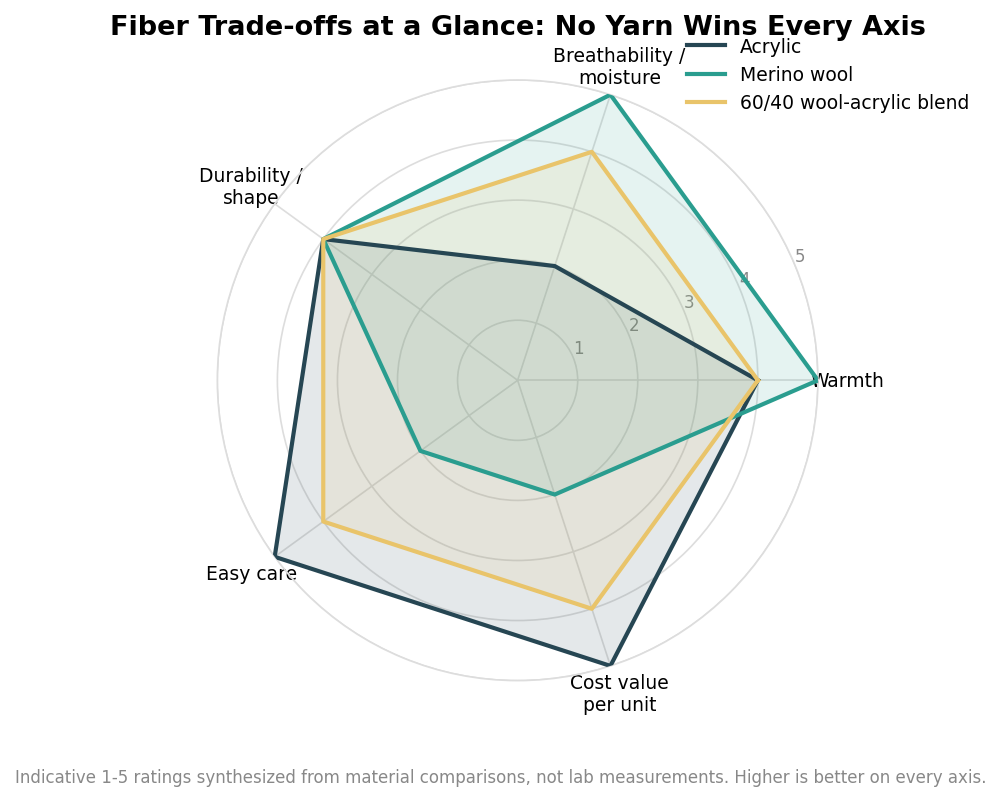
    Radar chart comparing acrylic, merino wool, and a wool-acrylic blend across warmth, breathability, durability, easy care, and cost value
    No single yarn leads on every axis, which is why the use case should pick the fiber.

    Acrylic: the default for bulk and branding

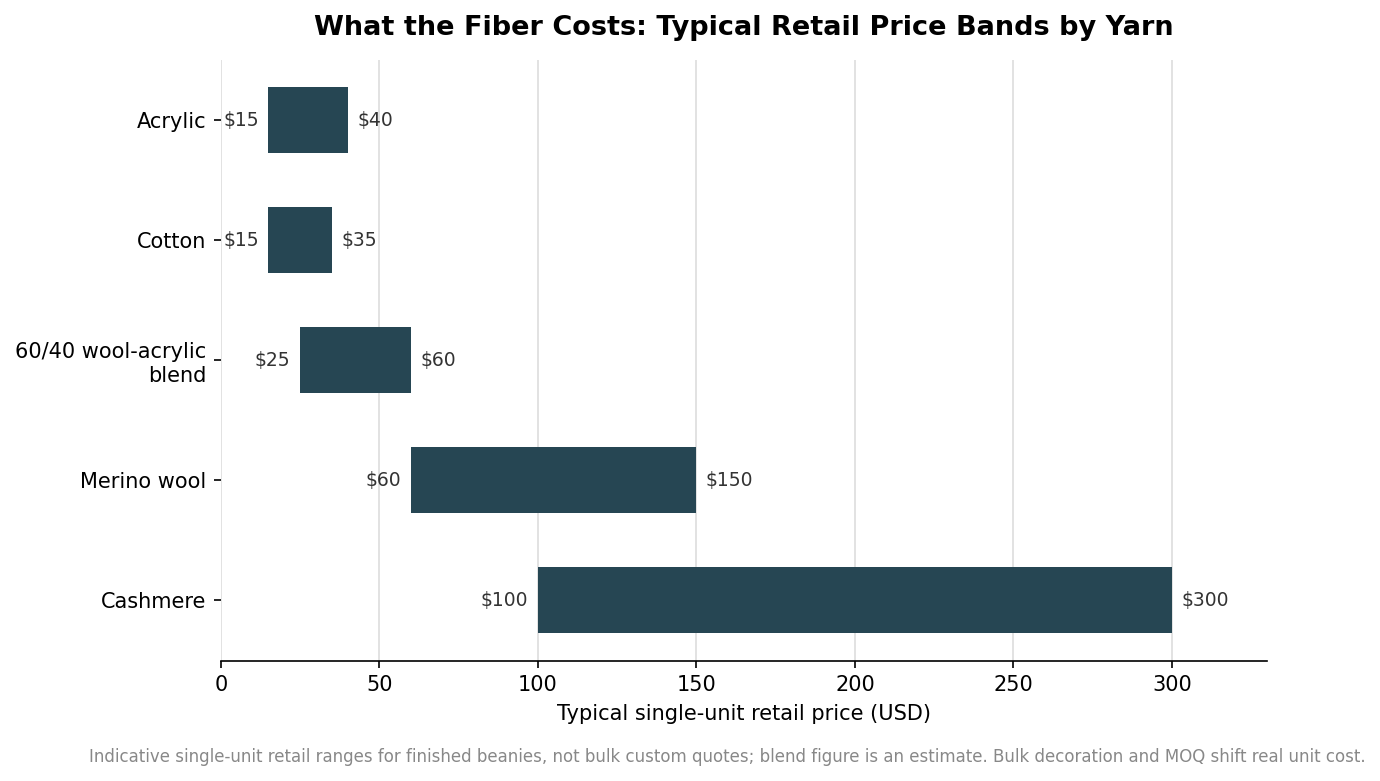
    Acrylic dominates custom and promotional beanies because it does the practical things well and cheaply. It insulates by forming air pockets, holds its shape over years of wear, comes in effectively any color for tight brand matching, and is machine washable and tumble-dry friendly, which matters when the hat is a giveaway rather than a treasured possession. It is also hypoallergenic and resists pilling better than many natural fibers. Typical finished acrylic beanies sit at the low end of the price scale, which is what makes large runs viable. The honest limitation is breathability: acrylic can trap moisture during hard activity, so a wearer who works up a sweat may feel clammy in a way they would not in wool. For everyday cold weather, tailgates, event handouts, and retail merch that has to hit a price, acrylic is usually the right default rather than a compromise.

    Merino and wool blends: when comfort and moisture matter

    Merino wool is the upgrade for hats worn against the skin during real activity. Its advantages are specific and measurable in feel: it is exceptionally breathable, it wicks moisture and can absorb up to around 30 percent of its weight in water before it feels wet, and it is naturally odor-resistant enough to wear repeatedly between washes. The itch that people associate with old wool is a function of fiber diameter, measured in microns; fine merino, generally around 18.5 microns and below, feels soft against the forehead where coarser wool over about 25 microns scratches. The trade-offs are care and cost: merino wants gentle, cool washing and flat drying, and it sits several times higher than acrylic on price.

    For most buyers the sweet spot is a blend. A common 60 percent acrylic, 40 percent wool construction keeps much of wool’s warmth and hand while adding acrylic’s easier care, better shape retention, and lower cost. A blend is the practical answer when you want the beanie to feel better than pure acrylic without the price and delicacy of full merino, which is why blends cover a lot of mid-tier headwear.

    Horizontal bars showing typical retail price bands for acrylic, cotton, wool-acrylic blend, merino wool, and cashmere beanies
    Fiber choice moves the price band far more than any other single spec.

    Cotton, fleece linings, and recycled options

    Some fibers earn a place for reasons other than peak warmth. Cotton knits are breathable and easy to care for, and they suit spring, fall, and mild-climate hats, but cotton is only a fair insulator and it loses warmth when wet and dries slowly, so it is a poor choice for deep winter or anything worn in the rain. Fleece linings, usually polyester, are a construction choice rather than a fiber choice, and they are one of the most effective ways to add warmth and wind resistance to a beanie in any outer yarn, at the cost of a little breathability. Recycled polyester yarns and recycled-content blends have become a real option for buyers who want a sustainability story on the hangtag; they perform much like their virgin equivalents while letting a brand speak to recycled content. Cashmere sits at the luxury extreme, lightweight and warm but prone to pilling, quick to lose shape, and demanding hand-wash care, which usually rules it out for anything but small premium runs.

    How the yarn changes decoration and care

    The fiber and the knit gauge quietly constrain how a logo should be applied. Fine-gauge knits give embroidery a stable, dense surface that holds crisp stitches, while chunky, low-gauge knits have gaps between loops that can swallow small text and distort fine detail, so bold, simple marks read better on them. A woven label or a patch is often the smarter route on very soft or delicate fibers like fine merino and cashmere, where dense embroidery can pull and pucker the knit. Color matters too: acrylic accepts a huge palette for exact brand matching, whereas natural fibers have a more limited, more muted range.

    Care instructions should follow the yarn onto the label, because a premium beanie ruined in a hot wash is a wasted spend. Acrylic and most blends tolerate machine washing and low tumble drying; merino, wool, and cashmere want cool, gentle washing and flat drying to keep their shape. Decide the use first, let it choose the fiber and the knit gauge, then match the decoration and the care label to what the yarn can actually take. Done in that order, the beanie is warm enough, comfortable enough, and durable enough for the way it will really be worn, which is the whole point of ordering a custom one.

  • Five Ways Custom Beanie Orders Go Wrong

    Five Ways Custom Beanie Orders Go Wrong

    Custom beanies look like one of the simplest things you can order. Pick a color, hand over a logo, choose a quantity. The reason so many orders still disappoint is that the failures are not obvious at the design stage; they show up on heads, in the cold, and in photos after the run is already made and paid for. Almost every one of them traces back to a small decision made without the right number in front of you. Here are the five that account for most of the regret, and the specification that heads each one off.

    Mistake one: trusting one-size to actually fit everyone

    A knit beanie stretches, but stretch has limits. The rib that lets a band expand also pulls back, and on a larger head that return tension turns into a red forehead line and a hat that creeps up all day. On a smaller head the same beanie slouches past the eyebrows. One-size works for a broad middle, roughly the same population a one-size cap covers, but if your group runs to the extremes, or includes both adults and youth, a single size is a compromise you are imposing on the people at the ends. When fit matters, ask whether the style comes in more than one size or a youth cut, and match cuffed versus longer slouch styles to how the group actually wears hats rather than to the sample on your desk.

    Mistake two: putting the logo where the cuff eats it

    The cuff is the most tempting place to stitch a logo and one of the worst. When the wearer tugs the band down, anything embroidered across the fold warps, and a design that sits too low can end up half-hidden inside the turn-up. The workable envelope is smaller than people expect: on a standard three-inch folded cuff, keep the design to roughly a two and a quarter to two and a half inch height, centered above the fold with margin top and bottom so the needle never has to punch the bulky edge or a rear seam. Route the stitching from the center outward so the knit’s elasticity spreads evenly instead of bunching to one side. Decide placement against these limits before you approve digitizing, not after you see it puckered on a sample.

    Grouped bar chart showing knit beanies need higher pull compensation and shorter maximum stitch length than woven caps
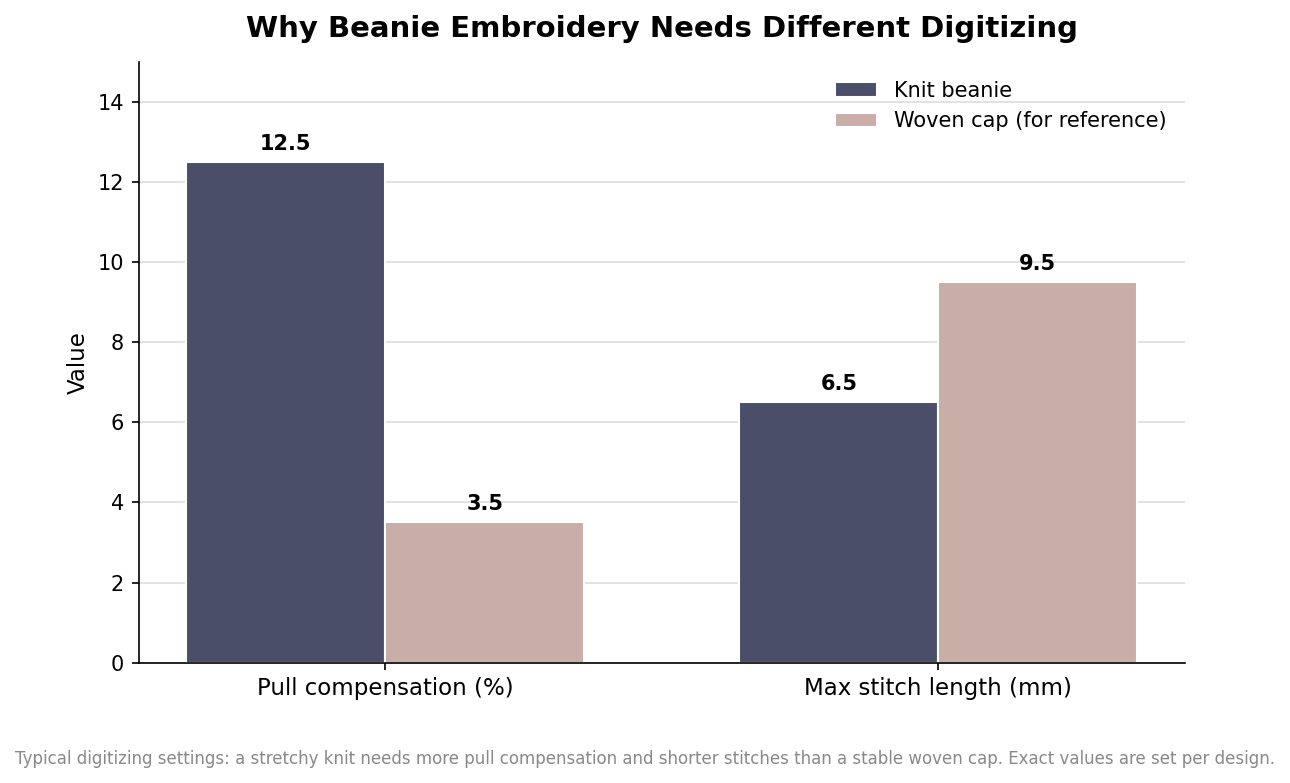
    A stretchy knit needs more pull compensation and shorter stitches than a stable woven cap.

    Mistake three: choosing acrylic when the weather needs wool

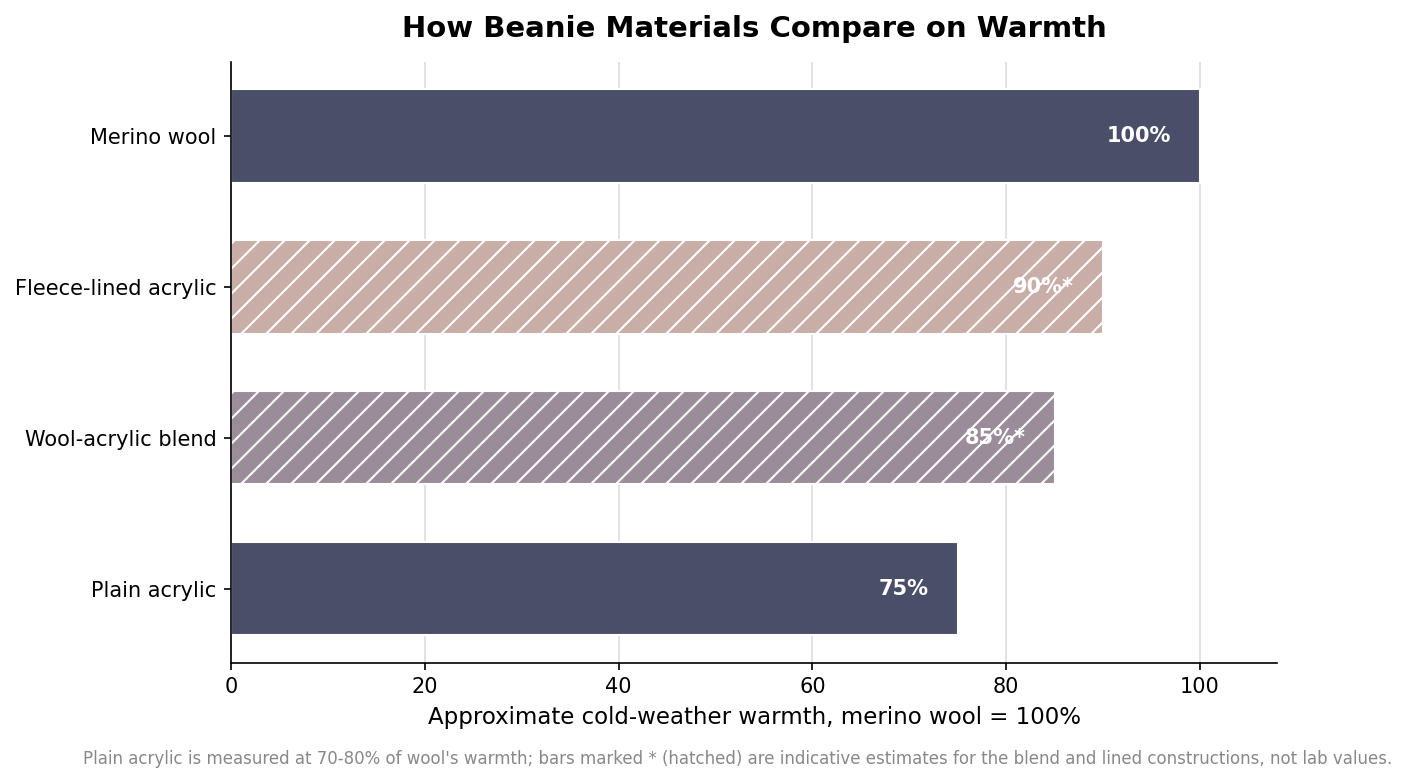
    Acrylic is smooth, affordable, pill-resistant, and completely fine for a mild winter or an indoor-to-car lifestyle. What it is not is a cold-weather insulator on par with wool. Measured against wool it delivers roughly 70 to 80 percent of the warmth, and its bigger weakness is water: acrylic loses much of its insulation once it is damp, while wool keeps warming even wet because its crimped fibers trap air. As a rough guide, acrylic is comfortable down to around 23 degrees Fahrenheit, whereas real cold below the mid-teens is wool or lined-beanie territory. Merino solves the itch that puts people off wool and stays soft, and a fleece lining or a Thinsulate layer is the middle path when you want acrylic’s price and washability with a real jump in warmth. Pick the fiber for the climate the beanie will actually live in, not for the swatch that felt nice indoors.

    Horizontal bar chart comparing approximate cold-weather warmth of merino wool, fleece-lined acrylic, wool-acrylic blend, and plain acrylic beanies
    Plain acrylic runs about 70-80% of wool’s warmth; lined and blended constructions close part of the gap.

    Mistake four: forcing heavy decoration onto a fine knit

    A beanie is a stretchy, open structure, and it fights ambitious embroidery. Because the knit moves, digitizing has to compensate far more than it does on a stable woven cap, typically pulling in 10 to 15 percent of pull compensation against 2 to 5 percent for a woven, and dropping the maximum stitch length to around 6 to 7 millimeters so stitches do not sink into the loops. Three-dimensional puff embroidery makes it harder still: encapsulating the foam demands close to double the stitch density, which drives up cost and slows the machines, and on a fine-gauge knit a dense block can distort the fabric around it. None of this means you cannot have a great logo; it means simple, appropriately sized designs read cleaner, cost less, and hold their shape. Save the heavy puff and oversized artwork for a chunkier gauge that can carry it, and let the digitizer tell you when a design needs to shrink.

    Mistake five: ignoring the calendar on a seasonal item

    Beanies are the definition of a dated product. They sell in a window, they are ordered for a specific drop or event, and that makes lead time the quiet killer of otherwise good plans. Winter merch that lands in January has missed the moment it was made for. Build the schedule backward from the date you need hats in hand, and treat the digitized proof as the real starting gun, because production cannot begin until you have approved how the logo is stitched. Confirm the minimum order quantity, the decoration method, and the ship date on your written quote up front; some decorators run low or no-minimum programs while others need larger runs, and the only figures that matter are the ones on your order rather than a general expectation. Approve the proof carefully and early, and the seasonal deadline stops being a risk.

    None of these five require a bigger budget to fix, only a decision made with the right detail in hand. Confirm the fit range, hold the artwork within the cuff’s usable window, match the fiber to the coldest day the beanie will see, keep decoration proportional to the knit, and start the clock from proof approval rather than from the deadline. Do that and a custom beanie order becomes exactly as simple as it first looked, with the difference showing up where it counts: on heads that stay warm and photograph well long after the run ships.

  • Custom Beanie Styles Compared: Silhouette, Fiber, and Knit Gauge

    Custom Beanie Styles Compared: Silhouette, Fiber, and Knit Gauge

    Two custom beanie orders can use the same logo and the same thread color and still feel like completely different products, because the things that decide how a beanie looks and wears are chosen before decoration ever enters the picture. The silhouette, the fiber, the knit gauge, and the fit all get locked in when you pick the blank. This is a selection guide organized around those four choices, so you can walk into a quote knowing which beanie actually fits your use case instead of defaulting to whatever the decorator has in stock.

    Start with the silhouette

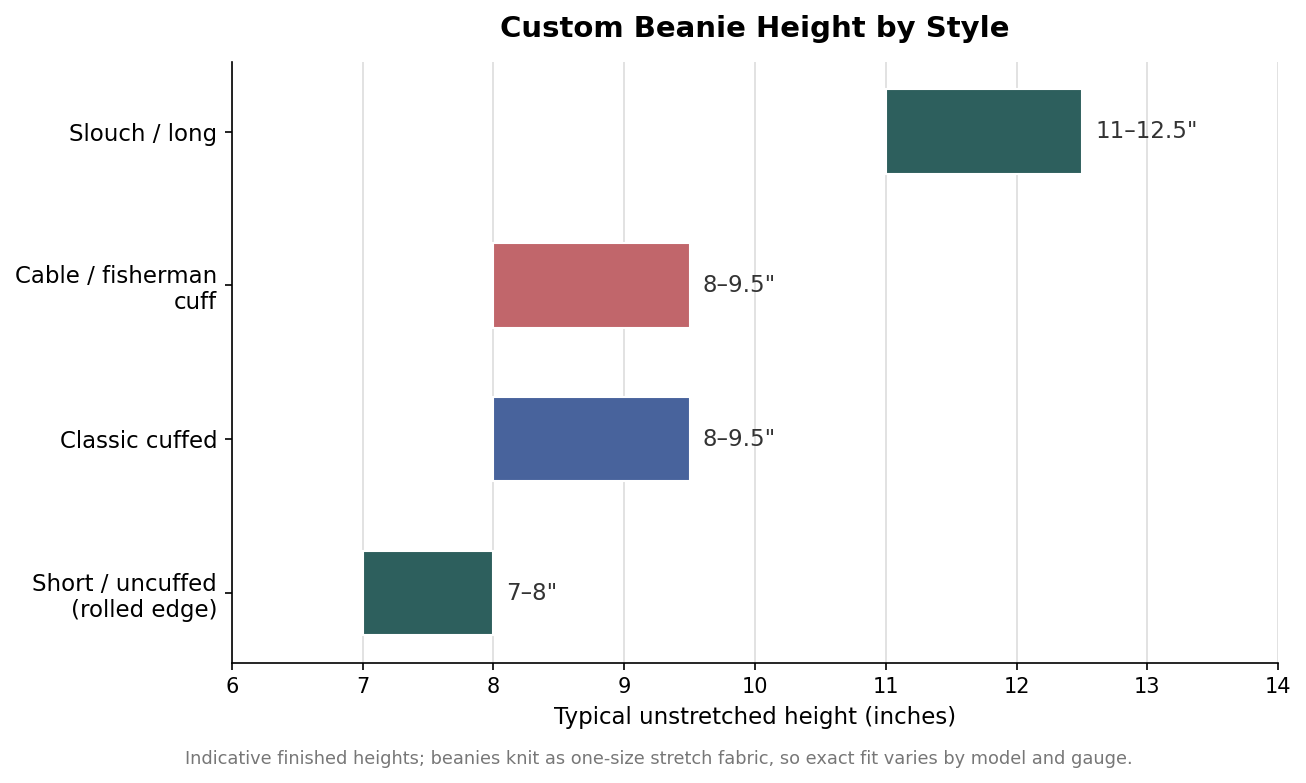
    The cuffed beanie is the safe default. A folded cuff gives a clean band for an embroidered logo or a woven label and suits almost any audience, from sports teams to corporate gifting. Common blanks in this family, such as the Yupoong 1501 cuffed knit, run a broad size range and sit at a familiar mid-height. The short or uncuffed beanie, often finished with a rolled edge, sits higher on the head and reads more modern and streetwear-leaning; it typically measures around seven to eight inches unstretched.

    The slouch or long beanie adds several inches of length, roughly eleven to twelve inches, so it drapes at the back for a relaxed look that skews younger. Cable and fisherman styles use a heavier, textured knit and a chunky cuff, giving a premium, cold-weather feel that photographs well on retail racks. A pom adds a playful, wintery note and is easy to spec as a removable snap-on if you want flexibility. None of these is objectively better; the right pick depends on whether you are outfitting a warehouse crew, a college club, or a boutique shelf.

    Floating bar chart of typical custom beanie height by style: uncuffed 7-8 inches, cuffed and cable 8-9.5 inches, slouch 11-12.5 inches
    Silhouette sets the whole feel of a beanie before any logo is added.

    Fiber choice: acrylic, wool, or a blend

    Acrylic is the workhorse fiber for custom beanies. It is affordable, holds bright colors well, resists shrinking, is machine washable, and insulates reliably, which is why the large majority of promotional and team beanies are 100 percent acrylic. Many popular cable and cuffed blanks are mid-weight 100 percent acrylic for exactly these reasons. The trade-off is that acrylic is less breathable than natural fiber and can pill over heavy use.

    Merino wool sits at the premium end. It is warmer for its weight, naturally breathable, and resists odor, which makes it a favorite for outdoor and higher-priced retail lines. It costs more per unit and often carries more specific care instructions, so it fits a product you intend to sell rather than give away by the hundred. Acrylic-wool blends are the sensible middle path: they recover much of wool’s warmth and hand-feel while keeping cost and care closer to acrylic. If you are unsure, a blend is rarely the wrong answer, but always confirm the exact percentage split, because a 90/10 blend behaves much more like acrylic than a 50/50 does.

    Knit gauge is the spec buyers forget

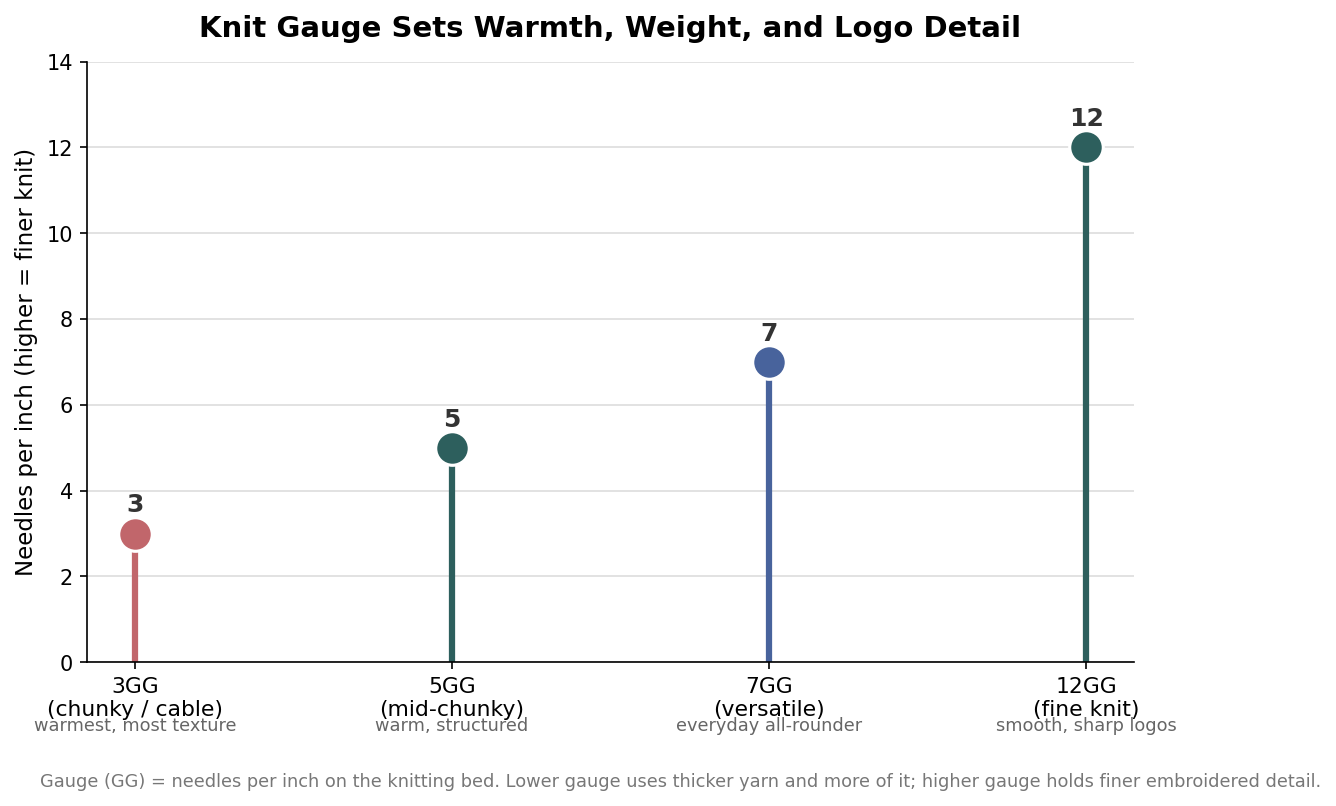
    Gauge, written as a number followed by GG, is the count of needles per inch on the knitting machine, and it quietly controls warmth, weight, and how crisp your decoration looks. Lower gauges like 3GG use thick yarn to produce a chunky, heavily textured, very warm fabric, and they use more yarn per hat. Higher gauges like 12GG use fine yarn to create a smooth, lightweight, refined surface. A 7GG knit is the versatile middle most everyday beanies land on.

    Gauge matters for decoration because a finer, smoother knit holds small embroidered text and sharp logo edges better, while a chunky low-gauge knit can swallow fine detail and pushes you toward a woven or leather patch instead. So the gauge decision is really a decoration decision in disguise: if your logo has thin lines or small lettering, lean toward a finer knit; if you want maximum warmth and a rugged texture and your mark is simple, a chunky knit delivers. Ask the decorator for the gauge of any blank you are considering, because two beanies that look similar in a photo can feel entirely different in the hand.

    Lollipop chart of knit gauge needles per inch: 3GG chunky, 5GG mid, 7GG versatile, 12GG fine knit
    Knit gauge quietly controls warmth, weight, and how sharp your embroidered logo can be.

    Fit, sizing, and quantities

    Most beanies are engineered as one-size stretch, knit from elastic fabric that conforms to a wide range of head sizes, which is why a single style often lists a broad size range and still fits nearly everyone. That simplicity is a real advantage for bulk orders because you avoid managing a size curve. Some structured or fitted styles do offer graded sizing, which matters if you are outfitting a uniform program where a consistent look is important, but for giveaways and most team orders, one-size keeps ordering clean.

    Because beanies are knit rather than cut and sewn from printed panels, decoration is applied to a finished blank, so minimum order quantities are usually driven by the decoration method and the blank supplier rather than the knitting itself. For a fully custom knit-in design, where your colors or pattern are worked directly into the hat, minimums climb substantially and lead times lengthen, so reserve that route for larger programs where the premium look justifies it. For most buyers, decorating a stock blank hits the best balance of cost, speed, and quality.

    Writing a spec that gets the right sample

    Bring four things to the quote and you will get an accurate price and a sample that matches your intent: the silhouette, the fiber and any blend percentage, the knit gauge, and the finished dimensions or size range. A brief that reads “cuffed beanie, 100 percent acrylic, 7GG, one-size” tells the decorator exactly what to pull, while “custom beanies” leaves every one of those variables open to a substitution you will only notice when the box arrives. Always request a physical sample before a large run, check the gauge against your artwork’s smallest detail, and match the fiber to whether this is a giveaway or a retail piece. The decoration gets the attention, but the blank is what people actually feel when they put the hat on.

  • Winter Merch That Actually Gets Worn

    Every marketing team has a cupboard of evidence that branded merchandise can fail. The jackets nobody claimed. The gloves in one size. The scarves that went home in a gift bag and never came back out. Cold-weather merch is expensive per unit, so when it misses, it misses loudly. Beanies are the reliable exception, and it is worth understanding why before you sign off on the alternative.

    The only test that matters

    Ask one question of any piece of branded gear: would this person have bought it for themselves? If the answer is no, you are not making merchandise, you are making a handout, and handouts get worn once out of politeness. A knit hat passes that test more often than almost anything else you can put a logo on, because most people genuinely need one and most people own fewer than they use.

    Why a beanie beats the alternatives

    Outerwear is the obvious cold-weather gift and the riskiest. It has to fit, it has to match a coat somebody already loves, and it costs enough that a miss hurts. Gloves have the same fit problem in a smaller package, and they are the single most commonly lost item in anyone’s winter kit. Scarves are a style choice, and style choices made on someone else’s behalf usually sit unworn. Umbrellas live in a car and never carry your name anywhere useful.

    A beanie sidesteps all of it. Rib knit stretches, so one adult size fits nearly everyone and the fit conversation disappears. It is small, so it travels in a pocket and gets carried rather than forgotten at home. And it is worn on the most visible part of a person, outdoors, where other people are looking.

    Wear time is the metric, not units shipped

    The useful way to judge winter merchandise is total wear time: units multiplied by the hours each one spends visible in public. A branded hoodie might be worn indoors, under a coat, mostly at home. A beanie worn on a commute from October through April is out in the open for a few hundred hours — on a train platform, at a school gate, in the stands at a game, in every photograph taken outdoors all season.

    That is also why beanies keep showing up in retail merchandise programs rather than only in giveaways. Breweries put them beside the glassware. Resorts hang them by the rental desk. Alumni offices sell them at homecoming. They move because people wanted a hat anyway and would rather have one that says something about them.

    What separates a kept hat from a drawer hat

    The difference is rarely the logo. It is four practical things.

    The knit

    A single-layer hat that stretches out after two wears reads as cheap immediately. A double-layer acrylic rib holds its shape, holds its color and stays soft. This is the decision that determines whether the hat gets picked up a second time.

    The restraint of the branding

    An oversized logo across the whole front is why people quietly stop wearing company gear. A mark sized to the cuff — roughly two inches tall, sitting flat on the fold — is legible and wearable at the same time. Tonal thread or a small woven label reads even better with a design-literate audience.

    The style match

    A pom pom hat is a delight for a resort shop and wrong for a construction crew. A short fisherman roll suits a coffee shop or a studio and feels too understated for a student giveaway. Fleece lining is a gift to anyone standing outside all day and unnecessary for an office. Matching silhouette to audience costs nothing and changes the outcome entirely.

    The finishing detail

    A custom label sewn inside the hat is a small, cheap touch that changes how the whole thing is perceived. It is the difference between a piece of merchandise and a piece of apparel, and people notice it on the first wear.

    Matching the hat to the audience

    Field crews want a fleece lined beanie in a dark color, cut roomy enough to sit under a hard hat, with a hi-vis option for anyone working beside traffic. Retail shelves want texture and a pom, in two or three colors, with an engraved patch or a woven label. Campuses want school colors in a cuffed knit, at a quantity that survives a homecoming weekend. Employee gifts want the understated version: a good knit, a small tonal mark, an inside label. New-hire kits want the same hat the founders wear.

    Timing beats budget

    The most common mistake in winter merchandise is not choosing the wrong item — it is ordering the right one too late. Demand for knitwear spikes in autumn across the whole industry, and the first cold snap is when everyone remembers. Standard production and delivery takes 2 weeks (faster turnaround available with express shipping), so working backward from your date with a fortnight of production plus a few days for artwork and approval puts you comfortably ahead. Ordering in late summer is calmer and gives you room for a second color once you see what moves.

    Start small, then reorder

    You do not have to commit to a season to find out whether beanies work for your audience. A first run of 12 is enough to put hats on a team, photograph them properly and see what the reaction is. Keep the artwork, yarn colors and stitch settings on file with your supplier, and the reorder matches the first run without starting the process again. Almost every buyer who tests a small run comes back for a larger one — not because the pitch was good, but because they watched people wear the hats.

  • The Buyer’s Guide to Ordering Custom Beanies

    Ordering custom beanies for the first time raises the same handful of questions for almost every buyer — stocking a merch shelf, outfitting a field crew, gifting staff at the holidays. This guide takes the decisions in the order they usually arrive.

    1. Pick the silhouette before anything else

    The shape sets everything downstream. A cuffed knit beanie is the everyday standard: double-layer rib folded into a deep cuff, warm at the ears, with a flat panel for decoration. A pom pom beanie is that same body with a faux-fur or yarn pom, and it outsells everything else in resort and holiday retail. A fisherman beanie is the short docker roll that sits high above the ears — the hat people who say they dislike beanies will actually wear. A waffle knit reads more like a boutique product, a fleece lined beanie is the workhorse for outdoor shifts, and a leather patch beanie is the retail finish.

    You do not have to choose only one: a single order can be split across styles and still count as one run.

    2. Yarn fiber: acrylic, merino or cotton

    Acrylic covers the majority of orders and is the default for good reason: it holds saturated color, will not felt or shrink the way untreated wool does, washes without instructions, and is the most economical fiber at bulk quantities. Modern acrylic is soft — the itchy reputation belongs to cheap knits of twenty years ago.

    Merino wool is warmer for its weight, breathes better over a long day outdoors and feels more premium in the hand, but it asks for a cold, gentle wash — so it suits retail customers and outdoor brands more than a giveaway crowd. Cotton and cotton blends are the lightest option: good for autumn, spring and indoor wear, and noticeably less warm. Choose cotton when the hat is a style piece rather than cold-weather equipment.

    3. Yarn weight and gauge

    Gauge is the second half of the fabric decision and the one buyers most often skip. Fine gauge yarn produces a light, close-fitting hat that shows embroidery detail crisply. Mid-weight is the everyday standard most people picture when they say beanie. Heavy gauge gives a chunky, structured knit that holds a fisherman roll upright and looks substantial on a shelf.

    The trade-off is simple: heavier yarn is warmer and carries bolder artwork well, finer yarn holds small text better. If your logo has fine lettering, say so early — it may push you toward a finer gauge or toward a woven label instead of thread.

    4. Sizing, and when one size stops fitting

    Rib knit stretches a long way, so one adult size genuinely covers most heads. Where it stops being enough is worth planning for: crews wearing hats under a hard hat need a roomier cut, and schools and family events usually want a shorter youth size alongside the adult run. A cuffed hat also sits shorter and snugger than an uncuffed one, which makes cuffed styles the more forgiving choice for a mixed group.

    5. Decoration and artwork

    Flat embroidery is the standard, with 3D puff, woven labels and laser-engraved leather patches as the alternatives. Send a vector file (AI, EPS, PDF or SVG) if you have one; a high-resolution JPG or PNG is workable, and a good supplier redraws and digitizes it free rather than charging a setup fee.

    Ask for a mockup showing the logo at true size, in position, on the yarn color you chose. Ours comes back within 24 hours with unlimited free revisions, because on a hat the common mistake is scale — artwork that looks right on screen and overwhelms a two-inch cuff in the real world.

    6. Color matching

    Dyed yarn does not land on a Pantone chip the way ink on paper does. Expect the nearest shade from the dye range, and expect a good supplier to tell you honestly where the gap is. Embroidery thread is the closer match, so brand colors usually land exactly on the logo even when the hat body is a shade off. An exact house color across a full run means custom dyeing — possible, but it adds time, so raise it at the quote stage rather than after approval.

    7. How many to order

    Our minimum order is 12 beanies, so a first run can be a test rather than a commitment. Stocking retail? Order a conservative first quantity in two colors and watch which one moves. Outfitting a crew? Count heads and add a margin for new starters and losses — hats disappear faster than shirts, because they live in trucks and coat pockets. Per-unit costs fall as quantities rise, so ask where the next tier starts before you settle on a number.

    8. Timelines: work backward from the date

    Standard production and delivery takes 2 weeks (faster turnaround available with express shipping), and the clock starts when you approve the mockup — not when you first make contact. Build in a few days for artwork and approval on your side, and if the hats are for a specific date, say the date in your first message. Autumn is the busy season for every knitwear supplier; ordering in late summer buys you calm.

    9. Packaging and delivery

    Bulk orders arrive folded and boxed by style and color with a packing list on the carton, which is what a stockroom wants. Going straight to a merch shelf or into gift kits? Ask about individual polybags or a hangtag. And if your people are spread across sites, ask for the run to be split across several addresses with separate tracking.

    A short pre-order checklist

    Know your silhouette, fiber and gauge. Have your logo file ready and know which decoration method suits it. Know your quantity, color split and in-hands date. Confirm that digitizing is free, revisions are unlimited, and nothing is knitted before you approve the mockup. With those settled, beanies are one of the simpler pieces of branded merchandise to buy well.

  • Embroidery, Woven Label or Leather Patch: Choosing a Decoration Method for Knit Hats

    A beanie is the only piece of branded apparel that stretches in every direction while somebody is wearing it. That single fact decides which decoration method belongs on it — and it is why a logo that looked perfect on your last run of hoodies can come back crowded, warped or cracked on a knit hat. Here is how the realistic options behave on a cuff, and how bulk buyers choose between them.

    Why a knit hat is not a flat garment

    Woven fabric holds still. Rib knit does not: it is a grid of loops that opens when the hat goes on a head and closes when it comes off. Anything applied to that surface has to move with it. Decoration that is rigid — a heavy ink film, a stiff transfer — fights the knit and loses. Decoration that is stitched or sewn into the structure moves with it and survives. That is the whole logic behind everything below.

    The second constraint is the panel. On a standard cuffed beanie you have a folded cuff roughly two and a half inches deep, of which about two inches is usable height and three and a half inches usable width. On a short fisherman roll you have less. Your artwork has to read in that space from across a room, which usually means simplifying it before anything else happens.

    Flat embroidery: the default, and usually the right answer

    Flat embroidery stitches thread directly into the cuff. It is durable, it moves with the knit, it survives repeated washing, and it reads as quality without trying. It is also the most forgiving method for orders that will be worn hard by outdoor crews.

    The craft is in the digitizing — converting your logo into a stitch file with the right density, underlay and pull compensation for a stretch knit. Done badly, embroidery drags the ribs together and puckers the cuff, or fills so densely that the hat stiffens across the brow. Done well, it lies flat and the knit still stretches underneath it. Ask two questions of any supplier: is digitizing included free, and does the mockup show your logo on the actual knit texture rather than on a smooth template? The answers tell you how seriously they take this step.

    Where flat embroidery struggles: type smaller than about a quarter inch tall, hairline strokes, gradients, and logos carrying more than roughly six colors. If your mark has any of those, keep reading.

    3D puff embroidery: louder, and pickier

    Puff embroidery lays foam beneath the stitches so the mark stands proud of the cuff. On bold block letters and simple shapes it looks excellent and photographs well on a shelf. On anything with fine interior detail it turns to mush, because the foam needs a continuous satin stitch to cap it cleanly. Treat puff as an option for a wordmark, a monogram or a single strong shape — not for a detailed crest.

    Woven labels: fine detail on a moving surface

    A woven label is a small fabric tag, woven with your artwork at thread level and then sewn onto the cuff. Because the detail is produced flat and attached afterward, a label carries lettering, thin rules and tonal shading that thread cannot hold at that size. It also reads as a designed product rather than a decorated blank, which is why apparel labels, roasteries and hospitality groups gravitate to it.

    Two things to know. A label is an added component, so it changes the surface of the hat: a tonal label on a matching yarn color looks understated, a contrast label announces itself. And a label is compact by nature, so it suits a tight mark. A wide horizontal lockup generally needs the deeper folded cuff of a standard beanie rather than a short roll.

    Leather and leather-look patches: the retail finish

    A patch is laser engraved rather than printed, so the mark is burned into the surface and cannot flake away. Fine serifs, thin outlines and detailed crests reproduce better here than by any other method available on a knit hat. Patches are cut to shape — rectangle, rounded corner, oval, shield or a custom outline that follows your logo — and the leather tone against the yarn color is most of the finished look, so mock up two or three pairings before you commit to one.

    The thing to verify is attachment. A patch stitched down on all four sides survives washing and a winter of being crushed into a coat pocket. A glued patch does not. Ask directly. Ask too for a vegan leather-look option if that matters to your audience; it engraves identically and comes in the same tones.

    What about screen printing?

    It is possible on a smooth, tight knit, and it is occasionally the right call for a one-off event hat carrying a large graphic. For anything expected to last a season, it is the weakest option: ink sits on top of a stretchy textured surface, so it cracks along the ribs after repeated wear and washing. If a supplier proposes print on a beanie without first asking what the hats are for, that is worth noticing.

    How to choose in about a minute

    If your logo is simple and the hats are going to a crew or a giveaway, use flat embroidery. If your logo is a bold wordmark and you want it to carry across a room, consider puff. If your mark has fine type or gradients and the audience is design-literate, use a woven label. If the hats are retail stock that has to justify a shelf spot, use an engraved patch.

    Whichever you choose, insist on seeing it as a mockup of the real hat, in the real yarn color, at true size before production starts. Scale is the thing first-time beanie buyers misjudge most often, and it costs nothing to fix on screen.