Custom beanies look like one of the simplest things you can order. Pick a color, hand over a logo, choose a quantity. The reason so many orders still disappoint is that the failures are not obvious at the design stage; they show up on heads, in the cold, and in photos after the run is already made and paid for. Almost every one of them traces back to a small decision made without the right number in front of you. Here are the five that account for most of the regret, and the specification that heads each one off.
Mistake one: trusting one-size to actually fit everyone
A knit beanie stretches, but stretch has limits. The rib that lets a band expand also pulls back, and on a larger head that return tension turns into a red forehead line and a hat that creeps up all day. On a smaller head the same beanie slouches past the eyebrows. One-size works for a broad middle, roughly the same population a one-size cap covers, but if your group runs to the extremes, or includes both adults and youth, a single size is a compromise you are imposing on the people at the ends. When fit matters, ask whether the style comes in more than one size or a youth cut, and match cuffed versus longer slouch styles to how the group actually wears hats rather than to the sample on your desk.
Mistake two: putting the logo where the cuff eats it
The cuff is the most tempting place to stitch a logo and one of the worst. When the wearer tugs the band down, anything embroidered across the fold warps, and a design that sits too low can end up half-hidden inside the turn-up. The workable envelope is smaller than people expect: on a standard three-inch folded cuff, keep the design to roughly a two and a quarter to two and a half inch height, centered above the fold with margin top and bottom so the needle never has to punch the bulky edge or a rear seam. Route the stitching from the center outward so the knit’s elasticity spreads evenly instead of bunching to one side. Decide placement against these limits before you approve digitizing, not after you see it puckered on a sample.
Mistake three: choosing acrylic when the weather needs wool
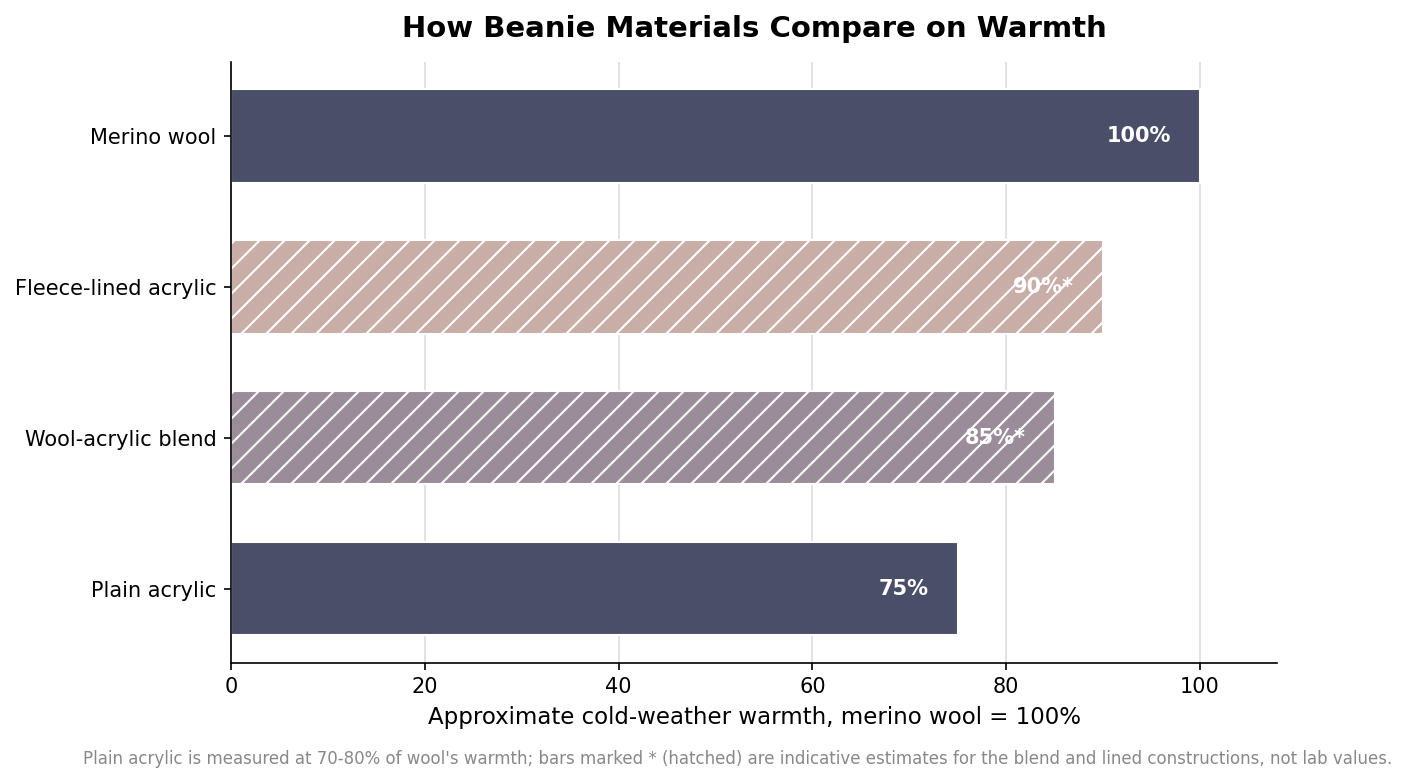
Acrylic is smooth, affordable, pill-resistant, and completely fine for a mild winter or an indoor-to-car lifestyle. What it is not is a cold-weather insulator on par with wool. Measured against wool it delivers roughly 70 to 80 percent of the warmth, and its bigger weakness is water: acrylic loses much of its insulation once it is damp, while wool keeps warming even wet because its crimped fibers trap air. As a rough guide, acrylic is comfortable down to around 23 degrees Fahrenheit, whereas real cold below the mid-teens is wool or lined-beanie territory. Merino solves the itch that puts people off wool and stays soft, and a fleece lining or a Thinsulate layer is the middle path when you want acrylic’s price and washability with a real jump in warmth. Pick the fiber for the climate the beanie will actually live in, not for the swatch that felt nice indoors.
Mistake four: forcing heavy decoration onto a fine knit
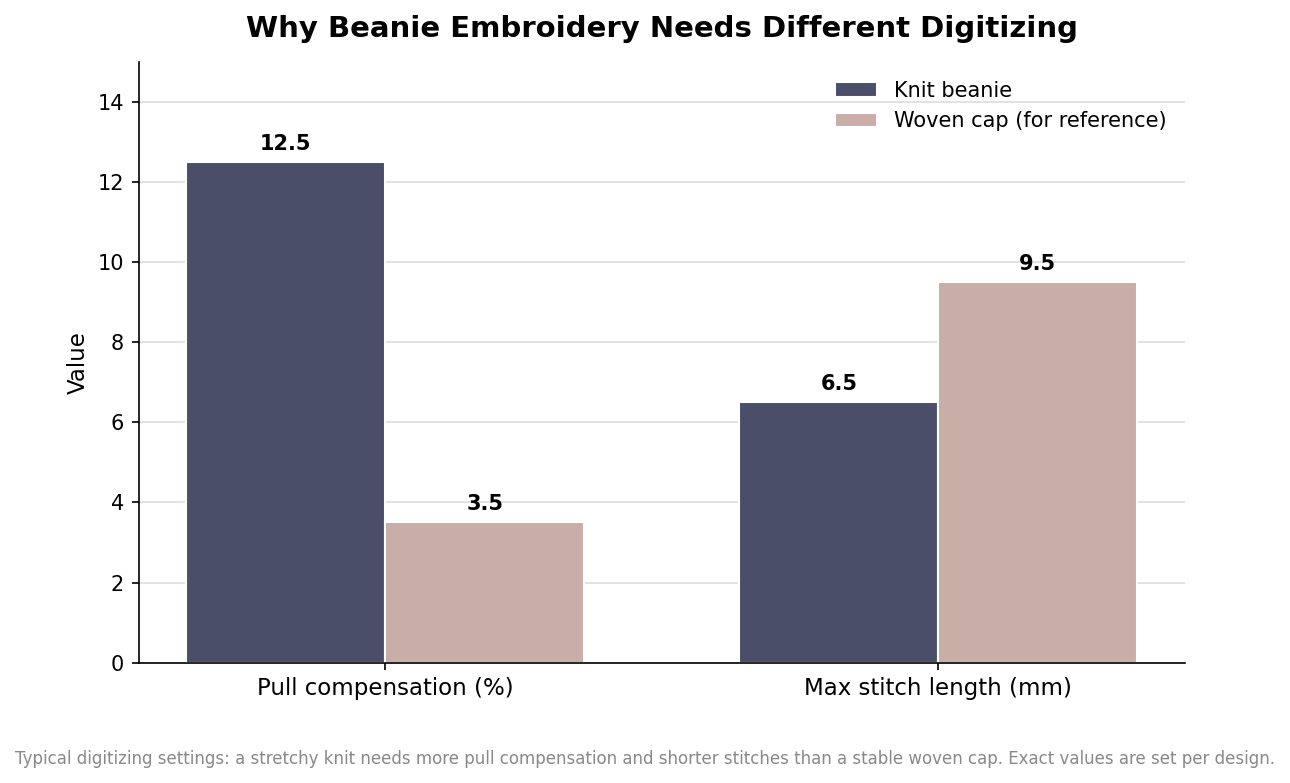
A beanie is a stretchy, open structure, and it fights ambitious embroidery. Because the knit moves, digitizing has to compensate far more than it does on a stable woven cap, typically pulling in 10 to 15 percent of pull compensation against 2 to 5 percent for a woven, and dropping the maximum stitch length to around 6 to 7 millimeters so stitches do not sink into the loops. Three-dimensional puff embroidery makes it harder still: encapsulating the foam demands close to double the stitch density, which drives up cost and slows the machines, and on a fine-gauge knit a dense block can distort the fabric around it. None of this means you cannot have a great logo; it means simple, appropriately sized designs read cleaner, cost less, and hold their shape. Save the heavy puff and oversized artwork for a chunkier gauge that can carry it, and let the digitizer tell you when a design needs to shrink.
Mistake five: ignoring the calendar on a seasonal item
Beanies are the definition of a dated product. They sell in a window, they are ordered for a specific drop or event, and that makes lead time the quiet killer of otherwise good plans. Winter merch that lands in January has missed the moment it was made for. Build the schedule backward from the date you need hats in hand, and treat the digitized proof as the real starting gun, because production cannot begin until you have approved how the logo is stitched. Confirm the minimum order quantity, the decoration method, and the ship date on your written quote up front; some decorators run low or no-minimum programs while others need larger runs, and the only figures that matter are the ones on your order rather than a general expectation. Approve the proof carefully and early, and the seasonal deadline stops being a risk.
None of these five require a bigger budget to fix, only a decision made with the right detail in hand. Confirm the fit range, hold the artwork within the cuff’s usable window, match the fiber to the coldest day the beanie will see, keep decoration proportional to the knit, and start the clock from proof approval rather than from the deadline. Do that and a custom beanie order becomes exactly as simple as it first looked, with the difference showing up where it counts: on heads that stay warm and photograph well long after the run ships.