Two custom beanie orders can use the same logo and the same thread color and still feel like completely different products, because the things that decide how a beanie looks and wears are chosen before decoration ever enters the picture. The silhouette, the fiber, the knit gauge, and the fit all get locked in when you pick the blank. This is a selection guide organized around those four choices, so you can walk into a quote knowing which beanie actually fits your use case instead of defaulting to whatever the decorator has in stock.
Start with the silhouette
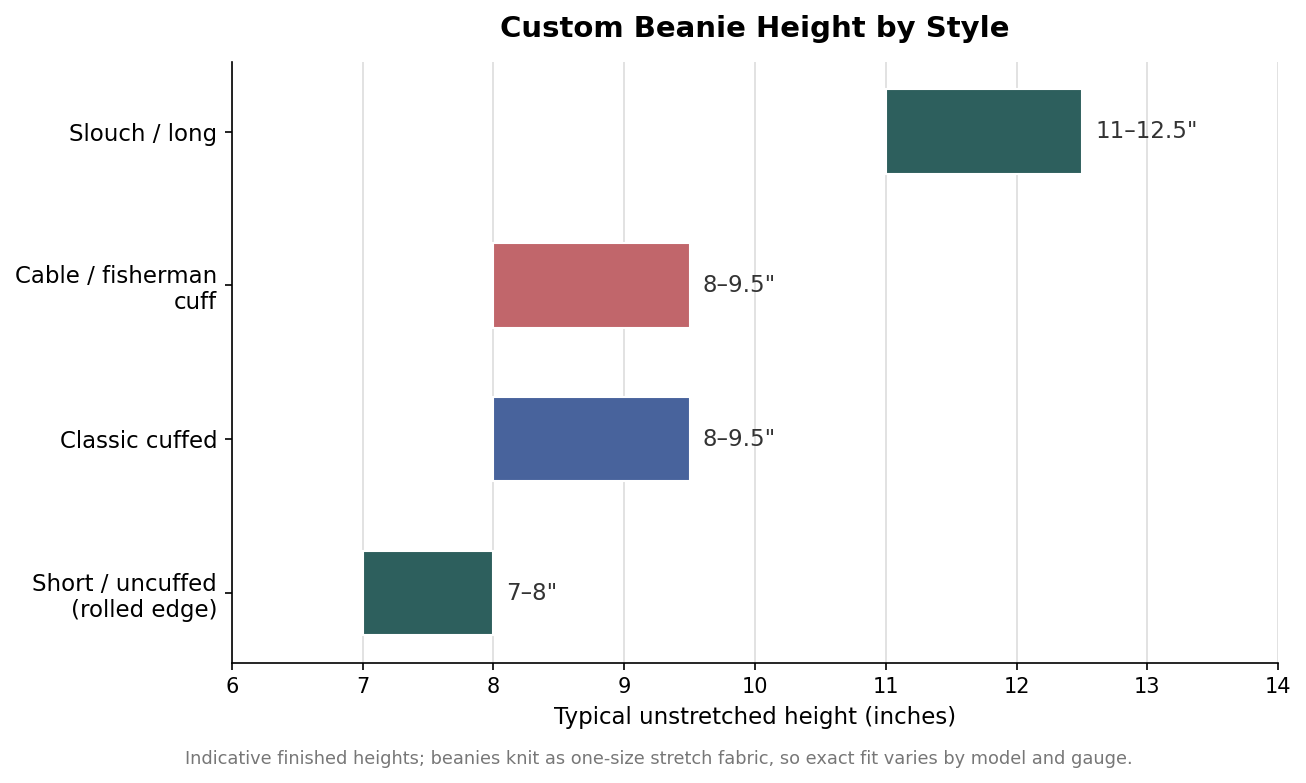
The cuffed beanie is the safe default. A folded cuff gives a clean band for an embroidered logo or a woven label and suits almost any audience, from sports teams to corporate gifting. Common blanks in this family, such as the Yupoong 1501 cuffed knit, run a broad size range and sit at a familiar mid-height. The short or uncuffed beanie, often finished with a rolled edge, sits higher on the head and reads more modern and streetwear-leaning; it typically measures around seven to eight inches unstretched.
The slouch or long beanie adds several inches of length, roughly eleven to twelve inches, so it drapes at the back for a relaxed look that skews younger. Cable and fisherman styles use a heavier, textured knit and a chunky cuff, giving a premium, cold-weather feel that photographs well on retail racks. A pom adds a playful, wintery note and is easy to spec as a removable snap-on if you want flexibility. None of these is objectively better; the right pick depends on whether you are outfitting a warehouse crew, a college club, or a boutique shelf.
Fiber choice: acrylic, wool, or a blend
Acrylic is the workhorse fiber for custom beanies. It is affordable, holds bright colors well, resists shrinking, is machine washable, and insulates reliably, which is why the large majority of promotional and team beanies are 100 percent acrylic. Many popular cable and cuffed blanks are mid-weight 100 percent acrylic for exactly these reasons. The trade-off is that acrylic is less breathable than natural fiber and can pill over heavy use.
Merino wool sits at the premium end. It is warmer for its weight, naturally breathable, and resists odor, which makes it a favorite for outdoor and higher-priced retail lines. It costs more per unit and often carries more specific care instructions, so it fits a product you intend to sell rather than give away by the hundred. Acrylic-wool blends are the sensible middle path: they recover much of wool’s warmth and hand-feel while keeping cost and care closer to acrylic. If you are unsure, a blend is rarely the wrong answer, but always confirm the exact percentage split, because a 90/10 blend behaves much more like acrylic than a 50/50 does.
Knit gauge is the spec buyers forget
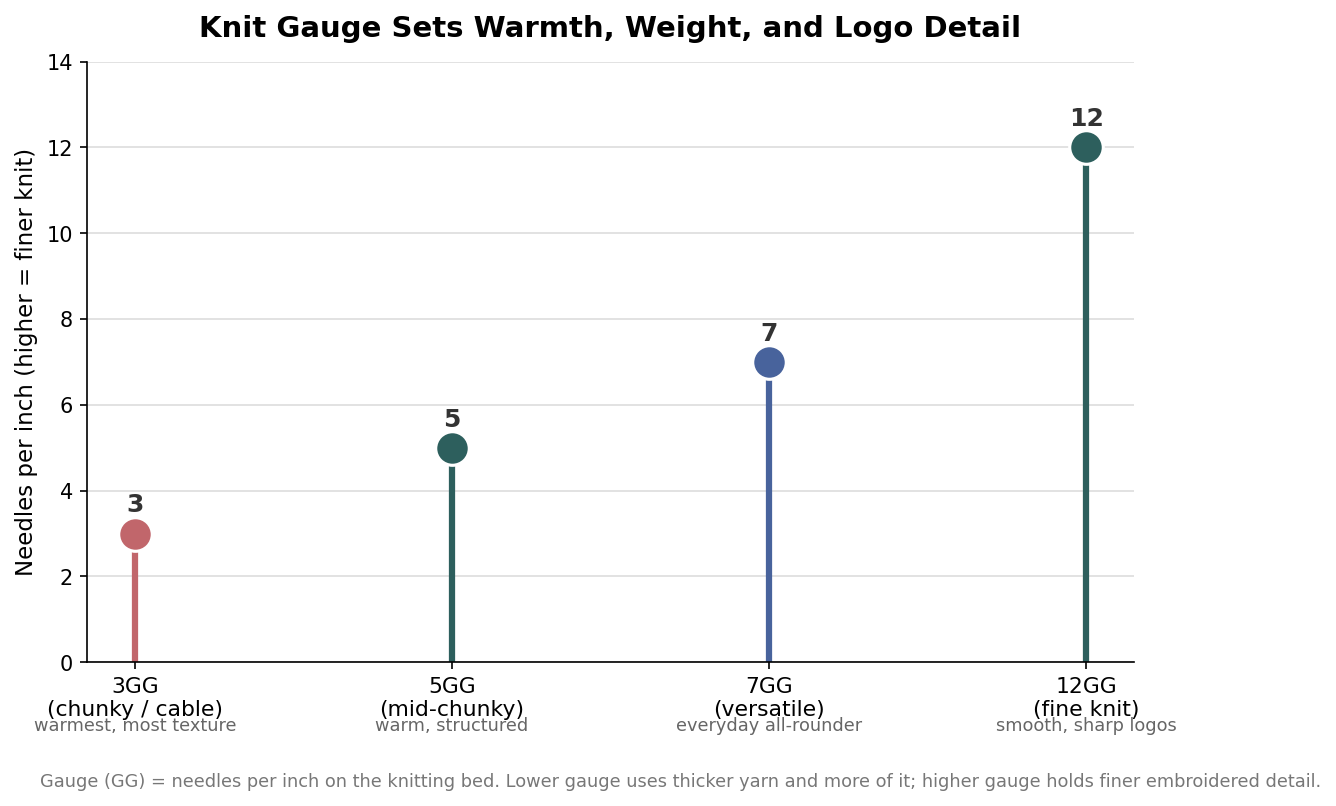
Gauge, written as a number followed by GG, is the count of needles per inch on the knitting machine, and it quietly controls warmth, weight, and how crisp your decoration looks. Lower gauges like 3GG use thick yarn to produce a chunky, heavily textured, very warm fabric, and they use more yarn per hat. Higher gauges like 12GG use fine yarn to create a smooth, lightweight, refined surface. A 7GG knit is the versatile middle most everyday beanies land on.
Gauge matters for decoration because a finer, smoother knit holds small embroidered text and sharp logo edges better, while a chunky low-gauge knit can swallow fine detail and pushes you toward a woven or leather patch instead. So the gauge decision is really a decoration decision in disguise: if your logo has thin lines or small lettering, lean toward a finer knit; if you want maximum warmth and a rugged texture and your mark is simple, a chunky knit delivers. Ask the decorator for the gauge of any blank you are considering, because two beanies that look similar in a photo can feel entirely different in the hand.
Fit, sizing, and quantities
Most beanies are engineered as one-size stretch, knit from elastic fabric that conforms to a wide range of head sizes, which is why a single style often lists a broad size range and still fits nearly everyone. That simplicity is a real advantage for bulk orders because you avoid managing a size curve. Some structured or fitted styles do offer graded sizing, which matters if you are outfitting a uniform program where a consistent look is important, but for giveaways and most team orders, one-size keeps ordering clean.
Because beanies are knit rather than cut and sewn from printed panels, decoration is applied to a finished blank, so minimum order quantities are usually driven by the decoration method and the blank supplier rather than the knitting itself. For a fully custom knit-in design, where your colors or pattern are worked directly into the hat, minimums climb substantially and lead times lengthen, so reserve that route for larger programs where the premium look justifies it. For most buyers, decorating a stock blank hits the best balance of cost, speed, and quality.
Writing a spec that gets the right sample
Bring four things to the quote and you will get an accurate price and a sample that matches your intent: the silhouette, the fiber and any blend percentage, the knit gauge, and the finished dimensions or size range. A brief that reads “cuffed beanie, 100 percent acrylic, 7GG, one-size” tells the decorator exactly what to pull, while “custom beanies” leaves every one of those variables open to a substitution you will only notice when the box arrives. Always request a physical sample before a large run, check the gauge against your artwork’s smallest detail, and match the fiber to whether this is a giveaway or a retail piece. The decoration gets the attention, but the blank is what people actually feel when they put the hat on.